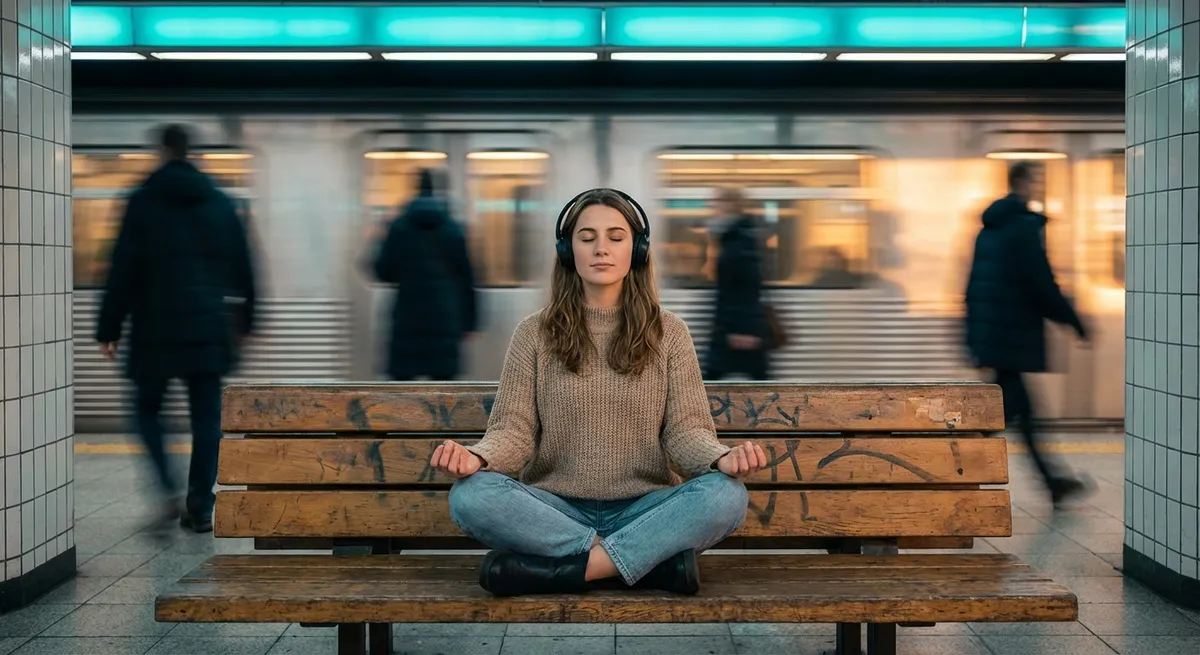

Quiet Power in a Loud World: Mindfulness for Right Now
If life feels like 47 tabs open in your brain, you’re not alone. Modern life runs in notifications, quick scrolls, and half-finished thoughts. Mindfulness isn’t about escaping that—it’s about learning to live inside it without losing yourself. It’s the quiet power underneath the noise, the part of you that doesn’t panic when everything else is going off.
This isn’t about becoming a “calm person.” It’s about becoming a present one. The difference is everything.
Mindfulness, Upgraded for the Modern World
Old narratives make mindfulness sound like you need a cabin in the woods and a 60-minute meditation practice before sunrise. Realistically, most of us have alarms, commutes, group chats, and a brain that wakes up with a to‑do list already running.
Modern mindfulness is less about escaping your life and more about inhabiting it:
- It’s not “stop thinking”—it’s “notice what you’re thinking without getting dragged under.”
- It’s not “add another task to your day”—it’s “change the way you move through what you already do.”
- It’s not “be zen all the time”—it’s “catch yourself sooner when you spin out, and come back faster.”
Research backs this up: mindfulness practices are associated with reduced stress, better emotional regulation, and more resilience under pressure. But the real magic is quieter—you start recognizing your own patterns. The moment you notice, “Oh, I always tense up before this type of meeting,” or “I always grab my phone when I feel lonely,” you unlock choice. Choice is where balance starts.
Think of mindfulness as running a subtle “awareness” app in the background of your day. It doesn’t shut everything else down; it just helps you see what’s actually happening so you can respond instead of react.
The Cost of Constant Noise (And Why Balance Feels So Far Away)
If you’ve ever thought, “I’m exhausted, but I didn’t even do that much today,” you’re brushing up against the hidden tax of constant stimulation.
Every ping, switch, and scroll is a micro-decision, and your brain is paying for it:
- Your attention is split, so everything feels harder than it should.
- Your nervous system stays on “alert,” even when nothing is actually wrong.
- Your down time doesn’t restore you because your mind is still sprinting.
Over time, this creates a strange combo: emotionally drained but physically restless. You want to relax, but your brain doesn’t remember how. This is where mindfulness becomes less of a “nice idea” and more of a survival skill.
Balance isn’t just “doing less.” It’s about having places in your day where your mind gets to land. Modern mindfulness is about building those landing zones into realistic lives, not fantasy schedules.
Let’s walk through five practical, zero-perfection tips that fit into the life you actually have.
1. Anchor Your Day with a 30-Second Check-In
Long meditations are powerful, but you don’t need them to begin. The real shift happens in micro-moments.
Try this three times a day: after you wake up, sometime mid-day, and before bed.
The 30-Second Check-In:- Pause whatever you’re doing.
- Notice one thing you can see, one thing you can hear, and one thing you can feel (like your feet on the floor or your back on the chair).
- Take 3 slow, deliberate breaths—in through the nose, out through the mouth.
- Ask yourself: “What’s here right now?” Don’t fix it. Just name it—tired, tense, okay, hopeful, numb, overwhelmed.
That’s it.
Why it works:
- You bring your nervous system down a notch.
- You start building a habit of turning toward your experience instead of running from it.
- You prove to yourself that mindfulness doesn’t require a perfect setup—just a decision to notice.
If you want to level it up, stack this check-in to something you already do: your morning coffee, opening your laptop, or brushing your teeth. Habits attach best to routines that already exist.
2. Turn One Routine Task into a “Single-Task Ritual”
Multitasking sounds productive, but your brain is actually just rapidly switching between things—and paying a price each time. Mindfulness invites you to reclaim at least one part of your day from this constant switching.
Pick one everyday task and turn it into a single-task ritual:
- Drinking your morning coffee or tea
- Showering
- Walking from your car/train to your building
- Washing dishes
- Prepping a simple meal
For that one task:
- No phone, no extra media, no “just one more thing.”
- Pay attention to the sensory details—the temperature, textures, sounds, smells.
- Notice when your mind wanders. Gently bring it back to what you’re doing.
You’re not trying to have deep thoughts or revelations. You’re just practicing being fully where your body already is.
This builds:
- Focus – training your brain to stay with one thing at a time.
- Calm – teaching your nervous system that not every moment has to be “on.”
- Satisfaction – a sense of completion in a world of endless scrolling.
When one small pocket of your day feels grounded, the rest of your day has a reference point. Your mind learns, “I can come back here.”
3. Redesign Your Relationship with Your Phone (Without Going Off-Grid)
Your phone isn’t the enemy; unconscious use is. Mindfulness here is about creating just enough friction to make your use intentional.
Try one or two of these tweaks:
- Move social apps off your home screen. Make them one swipe or folder deeper so opening them becomes a choice, not a reflex.
- Name your folders by intention: “Create,” “Connect,” “Consume.” It makes you ask, “What am I here to do right now?”
- Add a 5-second pause before opening an app. Ask: “What am I feeling, and what am I hoping this app will give me?” (Distraction? Connection? Validation? Escape?)
- Use built-in tools: set app time limits or scheduled “Do Not Disturb” blocks for focus or rest.
The goal isn’t perfect digital discipline. It’s awareness.
When you notice, “I always open my phone when I feel anxious” or “I scroll the longest when I’m lonely,” you’re not failing—you’re learning your emotional shortcuts. That awareness is the doorway to healthier ones: texting a friend, going for a walk, taking 10 slow breaths, journaling a single sentence.
In a hyper-connected world, one of the most radical mindful acts is to choose when you’re available—instead of living like you always are.
4. Listen to Your Body Like It’s Data, Not Drama
Modern culture trains us to live neck-up, as if our body is just a vehicle for our brain. Mindfulness flips that script. Your body is constantly broadcasting information: tension, fatigue, restlessness, subtle “no’s” and “yes’s.” Most of us have just gotten really good at muting the channel.
Once or twice a day, do a 1-minute body scan:
- Close your eyes if you can.
- Start at the top of your head and move down slowly: face, jaw, neck, shoulders, chest, stomach, hips, legs, feet.
- At each point, ask: “What’s here?” Tight? Warm? Numb? Achy? Buzzing?
- Don’t judge. Don’t fix. Just notice.
Then ask yourself one question: “If this sensation could talk, what would it ask for?”
- Tight shoulders might ask for a stretch or two minutes away from your screen.
- Heavy eyes might ask for sleep a bit earlier, or a break from blue light.
- A knot in your stomach before saying yes to something might be asking you to reconsider.
Listening to your body like data—not drama—helps you:
- Catch stress earlier instead of waiting for burnout.
- Notice which people, tasks, or environments consistently drain or nourish you.
- Make decisions that are aligned with how you actually feel, not just what you “should” do.
This is how mindfulness moves from “nice idea” to real-world decisions about work, rest, relationships, and boundaries.
5. Close Your Day with a 3-Point Reflection
Mindfulness isn’t just about the present moment; it also shapes how you remember your day. A lot of us go to bed replaying what went wrong, what we didn’t finish, or what we said awkwardly three hours (or three years) ago.
A short, consistent reflection can rewire what your brain highlights.
Before bed, try this 3-Point Reflection (on paper, in your notes app, or just mentally):
- One thing you actually appreciated today
Not “grateful to be alive” in a generic way—something specific: sunlight on your desk, a good meme, a kind message, a quiet commute.
- One thing you handled well (even if it was tiny)
You replied to a hard email. You took a break before snapping. You asked for help. You showed up even though you didn’t feel 100%.
- One thing you’d like to bring more mindfulness to tomorrow
A meeting, your phone use, your eating, your self-talk, or how you start your morning.
This isn’t toxic positivity. You’re not pretending everything is perfect. You’re simply giving your brain a more accurate snapshot of your day—one that includes both the challenges and the small wins and moments of beauty it usually overlooks.
Over time, this builds:
- A more balanced inner narrative
- A sense of progress, even in messy seasons
- A quieter, softer landing into sleep
Conclusion
Mindfulness doesn’t ask you to become a different person. It asks you to show up as the person you already are, with your full attention.
In a world that profits from your distraction, choosing to be present is quietly radical. It doesn’t mean your life gets instantly simpler. The deadlines, group chats, and responsibilities don’t disappear. What changes is your stance inside them.
You start noticing before you overload. You build tiny rituals that anchor you. You relate to your phone, your thoughts, your body, and your time with more intention and less autopilot.
Balance and fulfillment stop being abstract goals and start looking like this:
- You know how to come back to yourself, even on chaotic days.
- You feel your own life as you’re living it, not just in hindsight.
- You’re not just getting through your days—you’re actually in them.
That’s the quiet power of mindfulness in a loud world. Not an escape. A return.
Sources
- National Institutes of Health – Mindfulness Meditation: What You Need To Know - Overview of mindfulness, health benefits, and current research from a U.S. government agency
- American Psychological Association – Mindfulness Meditation: A Research-Proven Way to Reduce Stress - Summarizes psychological research on how mindfulness affects stress, attention, and emotional regulation
- Harvard Health Publishing – Mindfulness Meditation Improves Well-Being - Explains how mindfulness influences mental and physical health, with references to clinical studies
- Mayo Clinic – Mindfulness Exercises - Practical mindfulness exercises and guidance on integrating them into daily life
- UCLA Mindful Awareness Research Center - Educational resources, classes, and research on mindfulness in modern settings